
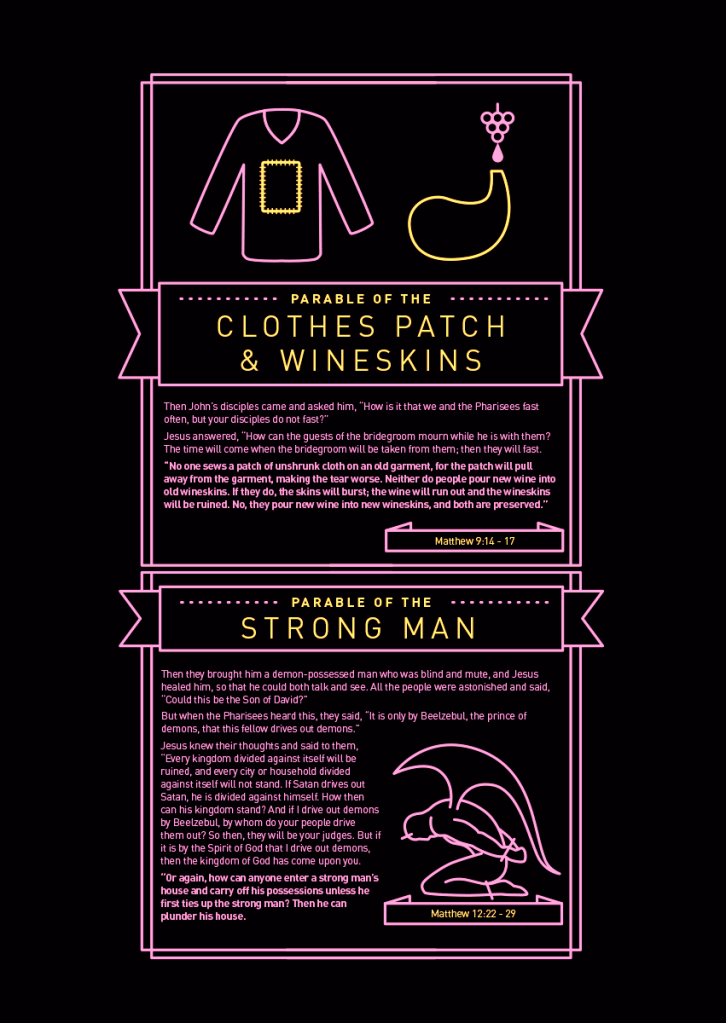
CLOTHES PATCH & WINESKIN
Jesus spoke this parable after he was questioned by John’s (the Baptist) disciples and the Pharisees as to why he consorts with tax collectors, the dregs of society? Jesus repeated his mission to them, that he came as physician to the sick, seeking to save sinners.
Not able to implicate Jesus in the disrepute of their own spiritual disciplines, they then pointed the finger at his disciples as to why they don’t fast, while they do. Jesus’s answer about the bridegroom is self-explanatory if not prophetic in predicting his own death, but he then follows it up with two quick and loaded illustrations.
Why did Jesus, known for his laconicism, give two illustrations when one would have sufficed? What is the difference or continuance between and of the two?
THE CLOTH
A new piece of cloth is only sewn onto an old piece of fabric if there is a tear, a rip, or in the context of ourselves as garments, a wound, placed there by an abuse from sin. The patch is therefore a form of healing. But it can only be sewn on after its been treated and this instance, ‘shrunk’.
Acutely aware of his audience, John’s disciples being in attendance, Jesus pointed to his own baptismal ‘washing with water’ by John. He was the patch, the healing of mankind and ‘shrunk’, made to fit man through baptism.
THE WINE
Jesus’s message is clear. New wine requires new skin. In this illustration he mentions old wineskins, new wineskins and new wine. What is missing is any mention of old wine. We know from the last supper account that wine is symbolic of Jesus’s blood, combined with the fact that the new wine is never in question, only the vessels that needed changing, means that Christ was casting himself as the new wine.
The old wineskin represented the law, as mediated by the Pharisees, while the new skins were the newly saved sinners. Christ was once again drawing that dividing line between the old covenant and the new, introducing a new religion, the new gospel of grace.
The Pharisees, who were devoted to the Old Covenant were unwilling to understand the practices of the New Covenant. Zealous for their religion they had drunk themselves full of the old wine and pronounced its superiority by claiming, “The old is better!”
The New Covenant required new vessels and new material. That’s why Jesus chose fishermen, tax collectors and zealots to carry his message because the “old guard” of Judaism struggled to embrace it. They were old cloth and old wineskins.
But old wineskins could be renewed by soaking them in water to soften them (Baptism), and then lubricating with oil to prevent evaporation (symbolic of the Holy Spirit which acts as sealant, metaphorically protected and preserving purity whilst walking through the world). If it weren’t possibly for old wineskins to be transformed then Jesus would not have admonished the Pharisee Nicodemus to be “born again”. (John 3:21)
The fermentation process of wine takes time, just as much as Christianity as a new belief system takes time to understand, develop and grow, which is why Jesus points out in Luke’s account that no-one ever desires new wine after tasting it for the first time, which is why they naturally default to the old. The stakes are high because as that curious concluding line states; “so that both the wine and the skin will be preserved”, pointing to our new bodies as a wrapper for our Christ-infused souls.
Matthew 9:14-17, Mark 2:18-22, Luke 5:33-39
…
STRONG MAN
When Jesus healed a demon-possessed man who couldn’t talk nor see, he illicits two opposite responses. While the people were astonished and for a brief moment wondered whether he was the prophesied Messiah (Son of David), the Pharisees exclaimed that he himself had a demonic spirit which allowed him to expel other demonic spirits.
Jesus then proceeded to challenge their reasoning with a number of questions to point out five crucial bits of understanding.
Firstly, he reasoned that Satan’s kingdom is not divided, therefore if he was destroying Satan’s kingdom by performing an exorcism then he must be stronger that Satan.
The second thing he points out is that by their rationale, the Pharisee’s own exorcists must also then have demons in them, and if that was so, then they are appointed as the Pharisees’ judges.
Thirdly, if he was indeed using God’s power, then it is evidence that he is from God, and that the Kingdom of God has arrived.
Fourthly, Satan will not permit anyone weaker to defeat him, so since he is helpless before Jesus means that Christ must be stronger than him, and therefore from God.
It is from Jesus’s fifth statement we can glean that he took umbridge at their accusation when he told them that all sins and every slander directed at him will be forgiven, except if they should blaspheme against the Holy Spirit.
What does blaspheming against the Holy Spirit mean? The Holy Spirit is a convicting power (John 16:8). If we therefore reject, deliberately ignore, harden our hearts to any calls by the Holy Spirit to confess a particular sin, we blaspheme against the Holy Spirit.
In Mark’s account this parable was book-ended by his family trying to control him, after which he not so much denounced them, but rather extended the definition of who his family is – anyone who does God’s will.
Matthew 12:22-29, Mark 3:20-30, Luke 11:14-28
 thankyoubackbone.com