
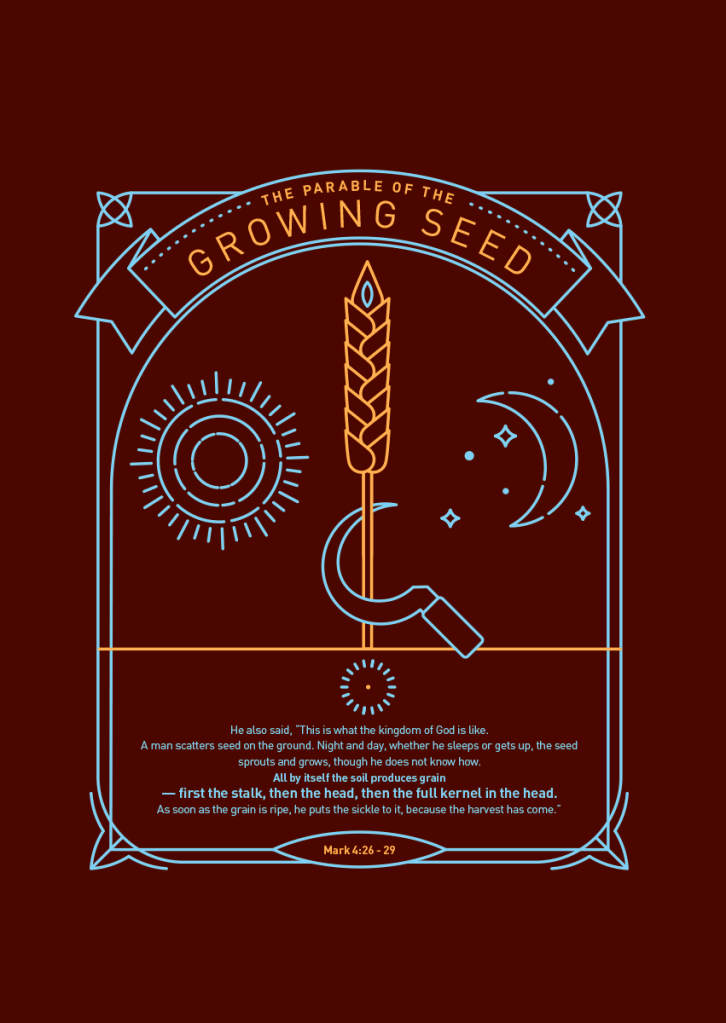
In Mark’s account this parable is sandwiched between two others, the parable of the lamp on a stand and following is the parable of the mustard seed. When viewed as a trilogy it is clear that all three parables have to do with the growth of Christ’s church, made up of individual members.
THE MAN
The man in this parable is not a skilled sower because he ‘scatters’ his seed. The man also can’t be God because God knows how a seed grows, whereas this man doesn’t know how.
THE SEED
The seed represents the Word of God, which also represents Christ. It could be said that God would have scattered Christ onto the ground, that is to say, given Christ to the world, which is true, but in this context the man does not know ‘how’ the seed grows, which means Christ is ‘scattered’ by some other means.
EVANGELISM
Evangelism is the act of professing our faith. First to ourselves, then to others. We might be able to trace the impact of our words on ourselves, but we certainly do not know how our faith-professing is impacting others. Nonetheless we as a Church are tasked to scatter Christ into hearts.
THE GROUND
“All by itself” are three important words because it denotes that the seed grows automatically, as if the soil at its creation had been instructed to ‘grow seed’ regardless of sun or moon, day or night.
Therefore, if Christ is the Word, then the soil represents our hearts. And here we have the great conflict. On one hand we have the human heart naturally disposed, wired to accept and grow the Word of God, while on the other hand we have the carnal mind which is naturally hostile to the word of God (Romans 8:7). Our core resides in our hearts (Proverbs 4:23). Therefore in our evangelism we need to reach hearts.
THE ‘HOW’ OF GROWTH
The stages of growth would seem obvious to an agrarian society; first the seed planted in good soil, watered, the roots are formed, then the stalk, the head and finally full kernel. The important take away in this context is that growth is organic. It takes time for a stalk to grow strong to carry the weight of the head and for the kernels to grow within. We have to be patient with the faith of others. We can therefore ‘evaluate’, but we cannot judge. Judging is a means of stating a premature conclusion, and a faulty one at that.
‘How’ the word grows in the hearts of people is God’s domain. It is not because He doesn’t want us to know but because it is too much information for us to digest if we consider how many people and situations He orchestrates to bring a single individual to redemption.
RIPE
“As soon as the grain is ripe.” Because new followers of Christ are born everyday while faithful followers die, at which point is an individual Christian mature? What does ripe look like? How do we know when we are ready for being sickled, cut down, removed? We can’t all reach maturity at the same time. Does ‘ripe’ even mean maturity? Is it even important we know when we are ready or is it information exclusive to God? Does it mean there are many harvests, not just one?
These are difficult questions to answer if the parable applies to individuals alone. If we however, consider that the parable is more about the body of believers, then it makes more sense and more likely that there is one harvest for the church.
Individuals can be at various stages of their personal growth, and certainly they are in the right environment to come to maturity already, but as a whole it is up to God to determine the ripeness of His Church.
THE SICKLE AND THE HARVEST
“As soon as the grain is ripe, he puts a sickle to it, because the harvest has come.” First, notice the perfect timing. The harvest has come because the grain is ripe, consistent with Jesus’s teaching in Matthew 24:14 that ‘the harvest’ is dependent on the Church and the gospel, and not on world events. Therefore ‘ripeness’ is likely to mean that the gospel has been preached everywhere in the world. Notice also that the harvest is dependent on the ‘fruit’ of the wheat, the full kernel in the head. Finally, what is also encouraging is that there is no delay. As soon as… there is the sickle.
What is the fruit of the Church? The book of Acts describes how the Holy Spirit built the first century Church and still builds the church. (The Acts of the Holy Spirit). Therefore the fruit of the Holy Spirit is as described in Galatians 5:22-23 as a perfect measure of maturity against which there is no law.
WHAT DOES THE SICKLE MEAN?
We’ve already established that this parable is talking about the collective, which means it cannot mean death as applied to individuals, but a physical removal of the wheat from the soil. One harvest, which denotes ‘the rapture’ – a physical removal from the earth into heaven for the marriage supper of the Lamb (1 Thessalonians 4:16). Jesus Christ wields that sickle, that removal as can be verified in the book of Revelation (14:14-16).
More profoundly we can consider that the heart also represents the ground, which means that our future life will not depend on our heart muscle, but on what it produces – the constant, secure proximity with our Maker. It is likely that we might not even need oxygen to go on living but only need the triune God living inside of us.
Mark 4:26-29
 thankyoubackbone.com