
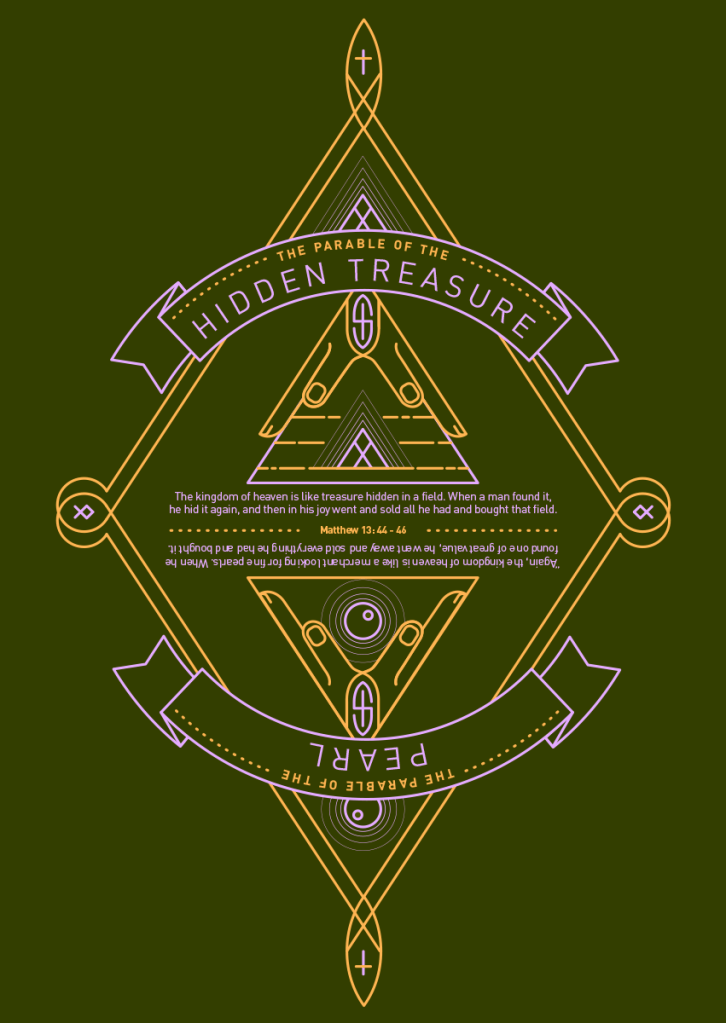
THE HIDDEN TREASURE
Once Jesus left the boat and the crowds he went into the house to deliver the meaning of the parable of wheat and tares, and then three further parables, totaling seven in all. Succinctly similar to the previous two parables here we have two remarkable sentences, two allegories packed with meaning.
THE TREASURE
Many valuable things in life, such as wisdom and love are ‘hidden’ and often we have to work really hard to posses those things. But if we say it’s valuable because it is hidden then that would not be true because nature and people itself, of immense value, is all around us. So what specifically is the treasure the man found?
There are two answers we can garner from two perspectives The first perspective is our own. If we are ‘the man’ then Christ is the ultimate treasure. The second perspective is that Christ is ‘the man’, and we are his treasure. Such is the love of Christ and for Christ that both perspectives are correct.
HIDING THE TREASURE
Why did the man hide the treasure after finding it and why do we hide Christ? The parable does not say why, but from my own experience I know I hid Christ for a long time because I was an infant and not confident in my faith. But he was also my treasure I was unwilling to share, because he made me feel special and exclusive. From Christ’s perspective the reason he hides us from the world is to protect us and reveal us, our ‘glory’, at the right and appropriate time. (Romans 8:18)
SELLING EVERYTHING
Why was the man joyful for this discovery? It was not because he now had immense wealth, but because he knew where it was, and what he needed to do to get it. The man was joyful because he knew where the burial site was, and happily proceeded to sell everything he owned.
My personal struggles as a Christian is that joy mostly eludes me, as I find little to celebrate in this life, but this parable is encouraging for the joy found here is in the burial site, in other words, remembering the resurrection of Jesus Christ, because he performs small, sometimes big miracle resurrections everyday in the lives of his loved ones.
The world tells us that if we let more things go we’ll be happier, but this parable states that only if we knew the location of our treasure and only because of this, will we be immensely joyful. Jesus verified this in his famous sermon when he said that “where our treasure is, will our heart (or core) be also. (Matthew 6:21). It goes without saying that humankind is itself a far greater treasure in the world than real estate or modes of transport.
Ultimately it was Jesus who sold everything he had through his death on the cross to acquire us. The point nailed home when even his clothes were sold after his death. But with his resurrection he acquired the field, and as such he now owns the entire Kingdom of Heaven – the world. The price he paid is higher than any of us could ever hope to collectively pay, which means he has say over our lives and what happens in his world, making all our free will and fist-shaking rather pitiful. We are in the world, but it is not ours to live as we want and do as we please. It is important to know this.
BUYING THE FIELD
Once we’ve sold everything comes the day we buy the field. The feat of buying the field means a number of things. First and most importantly, buying the field means that we’ve counted the cost, the cost being Christ’s sacrifice for us, and knowing its immense value we are willing to sell everything. Personally, Jesus dying for my sins is such a weighty thing, that it took a long time to sink deep so that when it came time to buy the field, signaled my total and utter commitment. My investment in buying the field is such that there is absolutely no going back, but the burning question is, have I sold everything?
Buying the field means that we don’t just discard all the things of significantly less value, but we sell it, so we can use the profits towards the purchase. This means we need to learn to live practically simpler lives so we can focus on gospel activities, selling what we don’t use. It also means we learn and become wise from adversity, because that too is selling to gain a profit.
Buying the field means that we have overcome the world because we no longer rely on the things we’ve sold. Buying the field means that I choose to live in this world and work towards its betterment, because I have discovered its treasure which lies buried in the world.
Why not just take the treasure out of the field and move it to another location? I could be partly because the treasure is too large, or that it might be stolen, disseminated and decimated away from the field, and partly because it is where the treasure belongs, in the field. But likely as we’ve already established the field is the world, therefore life does not exist outside of this world so that to remove the treasure is an unthinkable thought that possibly did not even enter into the man.
Ultimately the world does not and cannot exist apart and without Jesus Christ.
…
THE PEARL
Both perspectives still apply inasmuch as Christ is our pearl and we are Christ’s pearl, and the mutual giving up of everything to acquire it, makes us each others’. But what is different is why in this parable the merchant didn’t buy the ocean to acquire the pearl, like the man buying the field? Or conversely why did the man not buy the treasure like the merchant buying the pearl? The answer lies in the fact that the parable of the pearl follows the parable of the hidden treasure, like the new testament follows the old testament. The old testament contains the treasure that is Jesus Christ, hidden but not yet revealed, while the new testament reveals the specifics of that treasure as a pearl of great price, Jesus Christ. Every book in the old testament reveals that a Saviour is coming, while the new testament reveals the Saviour. It is the whole reason for the Bible.
THE MAN AND THE MERCHANT
One man discovers a treasure in the earth whilst the other scours the sea. The man buys the field but a merchant buys a pearl. The man’s vocation is not mentioned whereas the merchant’s profession is. While it’s not stipulated that the man was even looking for a treasure, it seems that the merchant, described as ‘intelligence seekers’ during the middle ages, spent his life looking for fine pearls. The merchant was therefore more discerning in his quest so that when he found the pearl of great price, he knew that it was without a doubt, very valuable.
Those who diligently seek truth and eternal life will find fine explanations, but only when their diligence leads them to scrutinize the life and teachings of Jesus Christ will they find it of a far greater value to the point of rendering all other explanations false. Believing in God makes all religions true, but believing in Jesus as God’s Son makes all other religions false. Christianity might be a treasure but Christ is the pearl, the nucleus of that treasure.
WHO I WANT MY CHILDREN TO MARRY
It is my heart’s desire that my children marry their Saviour. But it is also my heart’s desire that my children marry an earthly prince and princess, pearls of great price. From time to time I draw for them four circles, one inside the other. The outer circle I label ‘the world’, the next one in I mark as ‘Christians’. The third smaller circle I name ‘baptized Christians’ with the smallest circle at the center I write ‘lovers of Christ’. I then tell them it is not enough that their soul mate is a baptized Christian. They need to get to know them whether they are on a pilgrimage towards being a lover of Christ. Then only will they have found their pearl and their marriages will succeed. (Many couples have lived together for decades, but it does not means their marriage is successful. Without Christ they have settled for less.)
THE LAND AND THE SEA
The Bible is divided into two parts, the old and new testament. Two accounts of God’s plan for saving humankind. The first account, the old testament, describes the Nation Israel’s failed attempts at keeping God’s laws and thus sabotaging their responsibility of being a blessing to the Nations around them – an earthly treasure that remained hidden, dormant until Jesus showed up.
The second account, the new testament, describes how Jesus, God’s Son came to give himself for the church, the pearl. Therefore the collecting of the church is a heavenly calling. The old testament reveals the binary (earthly) nature of the law, whereas the new testament reveals the more nuanced good news gospel for a broader audience metaphorically represented as ‘the Leviathan’, a sea creature, in the book of Job.
Matthew 13:44-46
 thankyoubackbone.com