
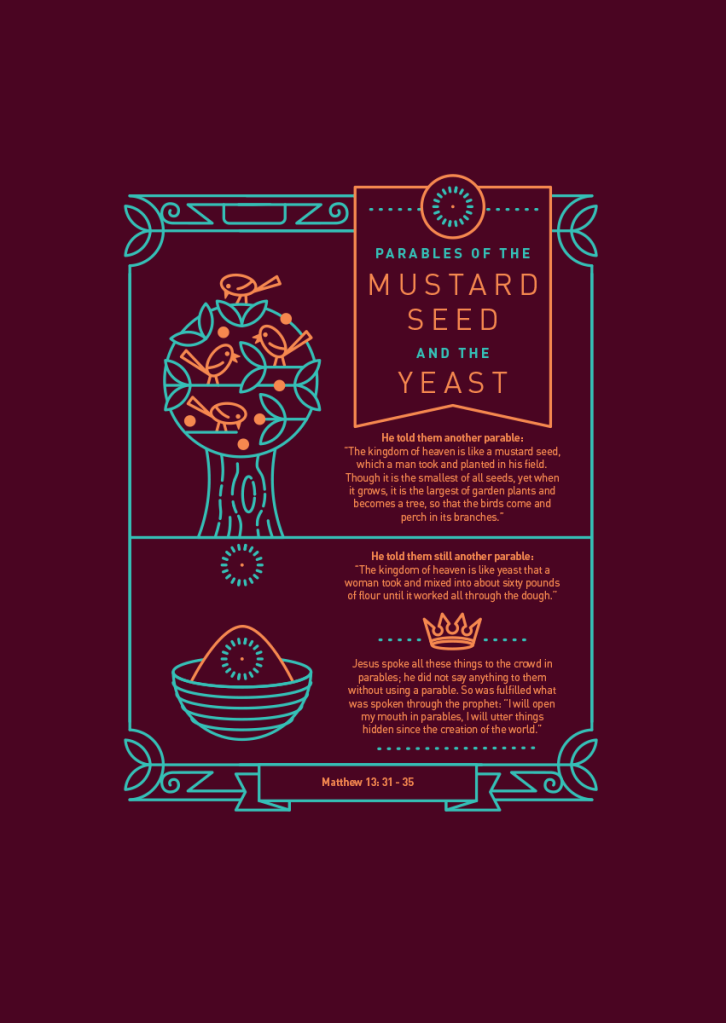
THE PARABLE OF THE MUSTARD SEED
A further extension of the previous two parables Jesus finally presents the last two in quick succession, and though they are short, sharp and punchy, they are characteristically loaded with meaning if not deliberately ambiguous.
THE CHURCH
It is important to note, as already clarified in the previous parable, that the Kingdom of Heaven represents the physical world with its spiritual perspectives and directives. The Church, although it operates ‘in’ this world is not ‘of’ this world but a very special and separate entity. (John 17:14-16). But even though the church is a microcosm of the world it is also itself occupied by wheat and tares.
THE SEED
Because the Bible interprets itself, it is likely that Christ was referring to himself as the seed (James 3:18), whom God took and planted in His field, the world, for the purpose of remaking and regrowing the world. As we already know Christ was born into poverty having had the smallest of beginnings and yet today we have a world filled with believers and lovers. This parable of the mustard seed also implies that the growth is quick even supernatural in the grand scheme of things, producing a refuge, a home, a tree which not only attracts but is the giver of life. Ultimately a foreshadowing of the tree of life in the book of Revelation.
There is also of course a personal application that if we take Jesus for ourselves, and plant him, invest him into every area of our lives, so that he becomes our filter through which we see the world, we ourselves will be enriched with all kinds of spiritual and ultimately physical blessings, so that we too can become a ‘tree’, a blessing to others, echoing that same promise God made to Abraham of which we are inheritors. (Genesis 22:17)
THE BIRDS AND TARES
Because this parable forms part of the ‘Magnificent Seven’ (four from the boat and three in the home) spoken on the same day, there are two things Christ mentions in the previous two parables, that when applied to this parable, gives a deeper, opposite and more sinister meaning.
1) First is the picture of the birds snatching away the seed in the parable of the Sower, now found here perched in the branches. We are not yet past judgment day where the world will be cleansed from the wicked, Satan and his demons, therefore those who ‘snatch away’ the truth from our hearts, eyes and ears are ever close. This makes the mustard tree also prophetic of the city Babylon which will rapidly and demonically be rebuilt during the seven year tribulation as a capital of wickedness. (There are many prophecies in scripture of Babylon’s ultimate destruction, none of which has occurred in history, therefore pointing to a future event.)
2) Secondly, when viewing the parable in light of the ‘tares’ it would come as no surprise that there are those who plant Christ as the seed for all the wrong motivations. Even though the same process applies, of Christ and his Word planted in the world, experiencing expansive growth and producing a large entity, we can deduce from Christ’s teaching between God and money as motivations (Matthew 6:24), that exponential ‘gains’ will be mark of the mustard tree. Just as ‘personal gain’ was once the marked difference between the tree of life and the tree of the knowledge of good and evil found in the garden of Eden. A dire warning for using Christ for personal wealth creation.
THE PARABLE OF THE YEAST
This the fourth and final parable in the boat has a similar message, of how rapidly and positively the Kingdom of Heaven spreads, working its guiding principles through and affecting everything in life. The negative difference however, is that the yeast figuratively represents sin (I Corinthians 5:6-8, Galatians 5:9), false doctrines (Matthew 16:6-12, Mark 8:15-21) and hypocrisy (Luke 12:1), which illustrates how the kingdom of heaven’s teachings, programs and even the very Word of God, the Holy Bible can be corrupted through wrong interpretation until it affects the world entire, which explains why judgment day is often referred to as a day of great separation.
Speaking of judgment day as the day of great separation is right and true, but apart from it being a specific day in the future the Lord exercises His judgment everyday through ordinary people who separate lies from truth. Judgement day is both a continuous event and a final day.
THE FLOUR
Sixty pounds of flour was the average size to feed a large household, intimating that the family environment is where everything, and this instance either the corruption of, or the faithfulness to God begins.
THE MAN AND THE WOMAN
A man plants the seed and a woman spreads the yeast. No doubt these were the gender roles of the day, but the responsibility, whether for sin or righteousness lies with both, as it did with Adam and Eve.
Matthew 13:31-35, Mark 4:30-34, Luke 13:18-20
 thankyoubackbone.com