
The Antonine Plague lasted fifteen years, from 165 to 180 AD. Uncannily also originating in China and decimated one third of the Roman empire, causing up to 2000 deaths a day in Rome, giving the disease a mortality rate of 25%. Far be it from me to call China and communism to account at The Hague for virus crimes against humanity, and in the age of modern medicine it would be heresy to holler that history is repeating itself.
But is history repeating itself?
The commentary on the pandemic’s been relentless, and yet surprisingly good. What struck me is that there are so many good insights from so many sources with so many good lessons to learn during this ‘unprecedented’ time, but will we and do we learn? (‘Unprecedented’. If have to hear that word one more time I might burst a blood vessel.) Every year Australia remembers Gallipoli under the banner of “lest we forget”, and yet as war still rages across the planet, it appears we do forget and we don’t learn. As someone once said; “the only thing we’ve learnt from history, is that we don’t learn from history.”
As usual the humanists are once again silent during these times of crisis for lack of adequate resources, but wading through the Kindness pandemic movement thankfully flattens my misanthropic curve, if I were to ignore the instances where kindnesses are flaunted as blatant self-serving masquerading as self-justification. As a people of faith we are bolstered through the reminders ‘not to fear’, ‘not to be afraid’, reassured that the Lord looks after His own. Good truthful advice, yet we at times still find ourselves scared primarily because we’ve been infected not by Covid-19, but by the reasonable fears of the unfaithful who insist on placing their trust in the things of this world, as behooves good secularists. Through all this there is but one itchy question I would like to scratch.
What precisely are we supposed to learn through this pandemic pandemonium?
I sat down and prayed, presenting this very question to my Heavenly Father in preparation to this monograph. The answer came immediately. “For every one of your questions Stephen, there is one hundred answers.” The rapidity of His response left some astonishment in the wake of why He seemingly appears silent much of the time. I say ‘appears’ because God is in fact giving us all one hundred answers to this pandemic simultaneously to absorb through our ears me dears. If we therefore compel ourselves to scrutiny in who we listen to, employing hindsight, foresight and insight, then undoubtedly we shall grow in wisdom, knowledge and lessons. I cannot give you all one hundred answers because quite frankly we each hold our own shrapnel to share. And so with this piece I have only four points for us to ponder together.
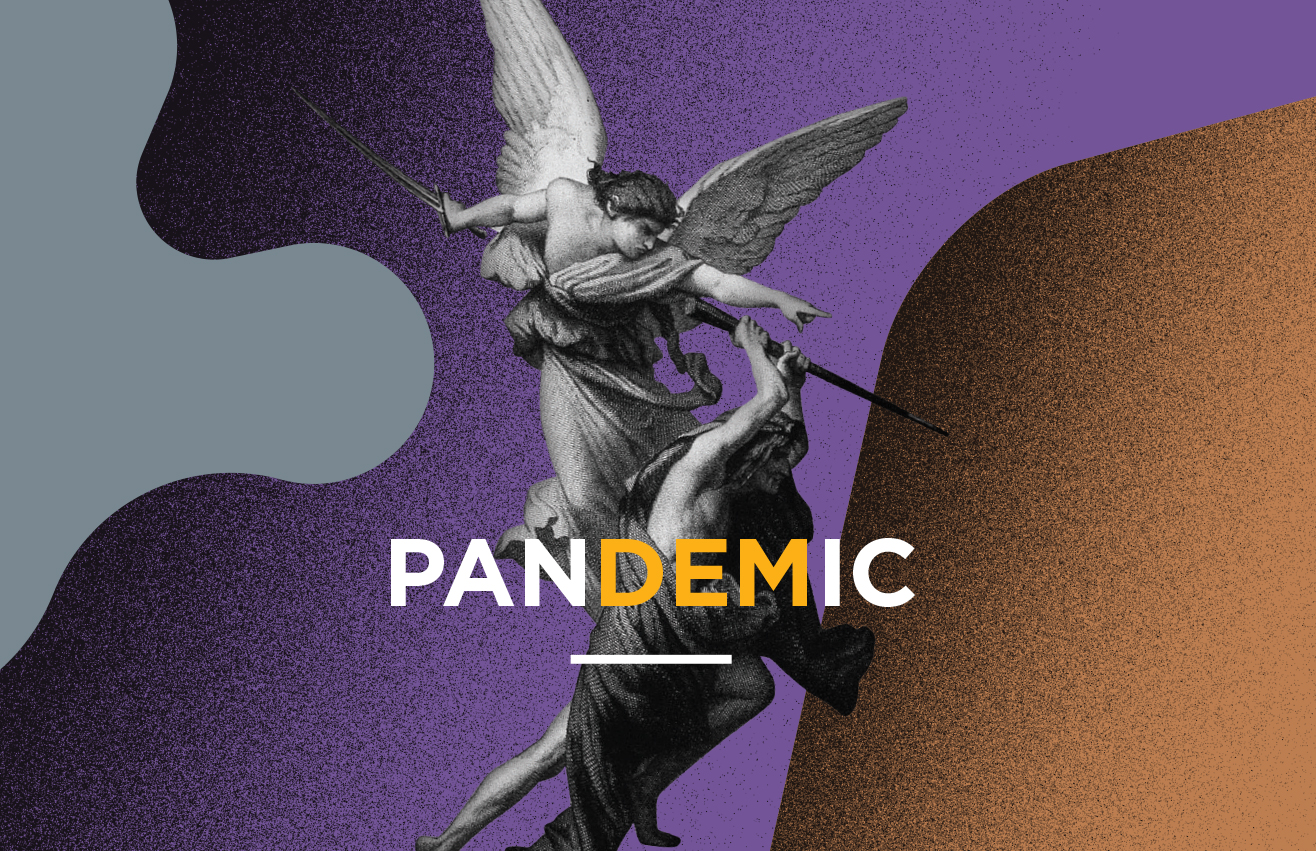
But before I do, I would like to share a warning, written by a man of God now eighty years ago. His caveat is that only some will take this or any ordeal to heart and be forever changed by it, while most will go back to the age of ‘endarkenment’ once the death angel has passed over.
“The human spirit will not even begin to try to surrender self-will as long as all seems to be well with it. Now error and sin both have this property, that the deeper they are, the less their victim suspects their existence, they are masked evil. Pain is unmasked, unmistakable evil; every man knows that something is wrong when he is being hurt. And pain is not only immediately recognisable, but evil impossible to ignore. We can rest contentedly in our sins and our stupidities but pain insists upon being attended to. God whispers to us in our pleasures, speaks in our conscience, but shouts in our pain: it is His megaphone to rouse a deaf world.
But the moment the threat is withdrawn, my whole nature leaps back to the toys: I am even anxious, God forgive me, to banish from my mind the only thing that supported me under the threat because it is now associated with the misery of those few days. Thus the terrible necessity of tribulation is only too clear. God has had me for but forty-eight hours and then only by dint of taking everything else away from me. Let Him but sheathe that sword for a moment and I behave like a puppy when the hated bath is over — I shake myself as dry as I can and race off to reacquire my comfortable dirtiness, if not in the nearest manure heap, at least in the nearest flower bed. And that is why tribulations cannot cease until God either sees us remade or sees that our remaking is now hopeless.”
(C.S. Lewis, The Problem of Pain; 1940).
What Lewis is saying is that man will discard God after this season of pain has passed because of their tendency to associate the misery of their trial with the one who supported them through it. Hosea says essentially the same thing: God, after observing how his people kept returning to idolatry – the very thing that hurt them – now too had no choice but to hurt them so they could return to Him. Why does God hurt them? Because He’s made from different stuff to us called ‘unfailing love’, in order to save us from fates worse than death, from what Job calls the ‘king of terrors.’ And that’s been the unfortunate cycle for thousands of years. As Job teaches; Satan presents his vile plan to inflict and infect mankind; God occasionally yet reluctantly acquiesces with some conditions, and in the end God in His wisdom uses Satan’s evil to produce unimaginable good. And there will be much good to come from this. It is what our Lord is supremely skilled at.
So what can we learn? Four quick things.
First
Yesterday on the BBC news website I saw two articles side by side. One article talked about the anxiety of school children now in isolation who tragically might not see some of their mates once they return. The other article about the benefits of polyamory, having multiple lovers. There it sits, side by side. What struck me is that though one affected the other and we most likely wouldn’t even notice. One is cause, the other effect. The world is succeeding in creating in us severe schizophrenia if we accept this as normal. Schizophrenia is ‘convenient’ because it prevents us from linking our squalor with our sins. Schizophrenia blinds us to linking climate change, poverty, war and disease with our selfishness. When we do catch a glimpse that we in some way might be responsible we pay some lip service through a show of petition or demonstration without a thought of turning to our deliverer for apology, which is the greatest sin of all. Make no mistake, God is calling us to change this cycle before He does.
Second
C.S. Lewis is correct when he writes that most of humanity consider God during the bad times but just as quickly forget Him during the good. We so much want to not be sheep but yet, here we are. How do we break this cycle? Prayer and praise. Paul admonished his new churches to ‘pray without ceasing’ and David left us a legacy of praise throughout the bad times, but more importantly how to do it during the good times. God calls us to a consistent life and therefore if we can pray and praise methodically, we will not only live counter-intuitively and counter-culturally, but break and free ourselves from many destructive cycles that cling to us like this virile virus.
Third
Last year God moved me out of media and entertainment and into an Ed-tech company. It was traumatic and althoughI I was exhilarated by the change I was also a bit confused by His move. Now with the crisis looming online-learning is one of the few business currently booming. I praise and love Him for His provision and His wisdom.
Governments shutting down what it deems non-essential services in favour of what it regards as essential services, makes for good meditation. Like the Ouroboros devouring his own tail the virus speaks, shrieking what pro-levers have been saying for years; that Abortion clinics, at least for now in two American states, are a non-essential service. Some might say that the virus is also astute about religion and they’d be right too, if it weren’t for the fact that abortion clinics cannot migrate online whereas churches are doing so quite easily. But as Ezekiel so eruditely wrote thousands of years ago, God’s throne has always been mobile because His Temple has always been his people not places.
The point I want to get to is that cycles are inescapable, because by breaking destructive patterns we are simultaneously placed in growth cycles. It is my prayer at this time that Church leaders go beyond just tessellating the beautiful gospel pattern, but all the way to the end pattern – Prophecy. The reason we hope is because this world’s bloody menstrual cycle will come to an end. The reason we do not fear is because the righteous will be taken away from the worst of God’s wrath yet to come. And the reason we are courageous in the faith is because there is a Kingdom imminent that will fulfil our every desire for peace, beauty and perfection.
Fourth
In his book, ‘The Book that Made Your World’, Vishal Mangalwadi presents a parable of his own. The parable of the two eggs. He shows his class two identical eggs but reveals that only one is fertilised and will produce life, while the other can not. How could they tell which is the fertilised egg? They couldn’t. Superficially they are both living organisms, but only one has been given a set of information that will determine its gender, colour and character. In fact that information is already transforming that egg from the inside out.
The majestic point Vishal makes is that the Bible is God’s information, His DNA , His fertiliser that is changing his followers on the inside until they should come forth as gold and glory into incorruptible bodies and sealed with the fruit and leaves of the tree of life. What a marvellous future, which brings me to the great pleasure I have in inviting you to that future, in Jesus’s glorious and most powerful name.
Amen

 thankyoubackbone.com