
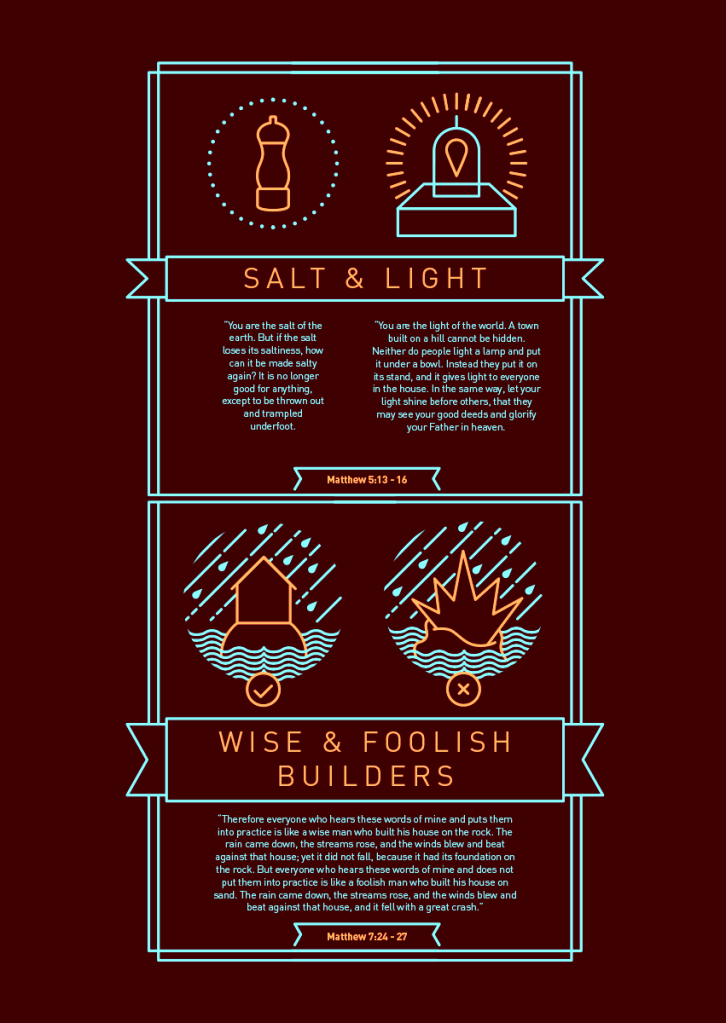
SALT & LIGHT
SALT
In Jesus’s famous sermon on the mount, which covers three chapters with lots of good teaching, we find this illustration of comparing his followers to salt. Salt was very scare in the ancient world and its value legendary, so much so that Roman soldiers used to get paid in the commonly used preserving agent in the days before refrigeration.
While the NIV translation uses the word ‘saltiness’ as the thing that might be lost, the King James translation uses the word ’savour’ in its stead, and certainly followers of Christ have been likened to all these adjectives, providing the colour and flavour to the world. And while the warning is dire, especially on the day of judgment at the end of this age, we know right now nothing is impossible for God, because Christ in us promises to resurrect and renew us to make us ‘salty’ again if that’s what it takes.
How does salt lose its saltiness? When it is exposed to the elements, such as sun, air and wind it becomes worthless, which is congruent with the corruption of Christianity through exposure to physical elements, manifested in the capitulation to societal norms which is invariably based on sinful pleasures.
THE PAIR
In Matthew’s account Jesus uses ‘Salt and Light’ as a pair, as if to make the point that while salt is scare and valuable, its ultimate destiny is to be prolific and shared with the whole world. Because of the reference of unsalted salt being ‘trampled under foot’, not something that will happen to Christ’s church, makes it likely that Jesus addresses the ‘individual’ in the salt parable while addressing ‘the Church’ community in the light parable.
In both Mark and Luke’s account Jesus follows the parable of the Sower with this light simile to make a different point altogether, that everything hidden will be concealed, and closes with a warning to consider carefully HOW we listen, because we can either gain more, or lose altogether what we think we have.
How do we hear well? By putting scripture into practice, by responding to God in praise, by writing down its garnered insights, like I’m doing here, and by teaching it first to our households, our children, and then to others. This is hearing well.
LIGHT
The characteristics of the light in this parable is that it represents a town, built on a hill, and with the reference of a lampstand it becomes a light that is raised to the highest point, only something that Christ in us can achieve. The overarching characteristic of light is of course to provide clarity and vision to the people in a household (the church), but also to the world (the hill).
Jesus’s primary occupation is to raise his Church to the highest place in the universe, which is verified in the first chapter of the book of Revelation where he ‘walks among the lampstands’. He does so by invading our hearts and souls upon our invitation to help us achieve his expectation, which is to have us be visible in our acts of good deeds.
THE PURPOSE
The purpose of Jesus’s mission is for people to see what we do, and then glorify God. Most people attribute good deeds to the person and spare no thought whether God is involved or not. How then would people observing good deeds ever compliment God before us?
The answer is very nuanced. If our audience once knew the individual as an utter rake but now witness uncharacteristic goodness, they are likely to praise God, if and only if, they knew it was because the person now follows Christ. But it would also depend on the deed. Certain deeds always make the headlines because of its ‘supernatural’ nature, for example, how a family is able to forgive their daughter’s murdering rapist are more likely to turn eyes towards heaven instead of the family, if and only if, the audience understands enough about sinful human nature.
How is God Glorified?
According to the scriptures God is glorified when bodies are healed or resurrected, Christ’s redemptive work is honoured, prayer is answered, much fruit is produced, God’s work is completed, salvation and miracles are performed and gifts are properly administered. Through good works, martyrdoms, clean bodies, generosity, professing our Christian faith and praising God.
Matthew 5:13-16, Mark 4:21-25, Luke 8:16
…
WISE & FOOLISH BUILDERS
This concluding parable came at the end of Jesus’s sermon on the Mount, where he again divided his audience into the wise and the foolish. Those who hear well and subsequently ‘do’, and those who don’t. Those who build their house on the security and surety of rock, which is Jesus himself (Ephesians 2:20), and those who build on sand.
The rain coming ‘down’, the streams rising ‘up’ and the winds beating (sideways) denotes that there will be absolutely no escape for anyone who builds their belief system on anything other than Christ, ruler of this world, and on the day of judgment, where there will be an absence of mercy, the decimation thunderous.
Matthew 7:24-27, Luke 6:46-49
 thankyoubackbone.com