
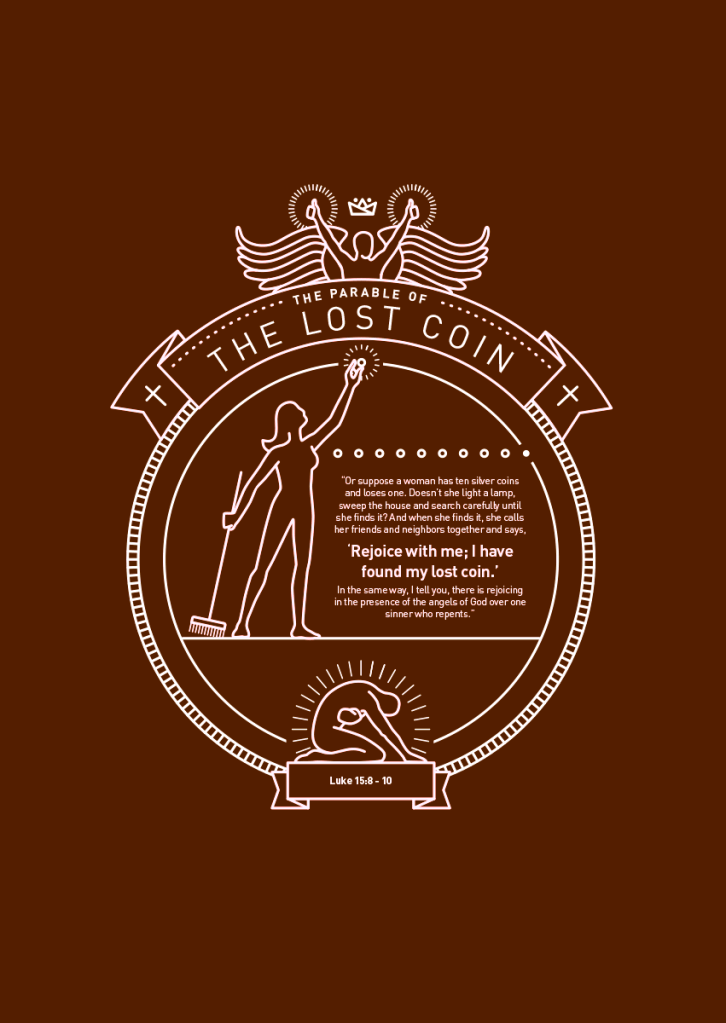
THE THREE PARABLES TOGETHER
It’s important to read all three parables dealing with the lost together, because while the sheep and coin deal with the heedless and thoughtless sinner who obeys his sinful dictates without realizing it, the parable of the lost son deals with a responsible agent capable of moral choices and in this instance a son who already knows the love of the Father but rejects it.
While the Holy Family, in which we as the righteous by faith are included, have a responsibility of bringing sheep and coins back into God’s design, the lost son as we shall see, has the personal responsibility to return on his own.
THE MAN AND THE WOMAN
A ‘man’ tending sheep and a ‘woman’ keeping coins is not just God covering each gender’s responsibility, but emphasizes differing responsibilities. The man symbolizes Jesus who has the weighty responsibility in tending the one hundred sheep, while the woman, in scripture symbolic of the Church, has a different mandate in looking after ten coins. Both operate according to God’s purposes.
TEN COINS
There are two meanings to the ten coins. Firstly they represent the Ten Commandments and secondly they represent those who belong to Christ. Similar to the previous parable the ten coins is a specific and allocated number. But more importantly it is also a currency – something that can be exchanged for eternal life in the Kingdom, both the adherence to the commandments (Proverbs 7:2) and the saving of lost sinners (James 5:20).
THE LOST COIN
Because the coins represent both people and commandments means that both a person and a commandment can be lost. Yet one is very dependent on the other because commands for good living are made for people to honour their design. Therefore a person becomes lost because a commandment is not being kept. To compound the problem James poignantly points out that when we break one commandment we break them all (James 2:10).
However, now that the Kingdom of Heaven has arrived representing the entire world, it casts all who have not yet known God as lost coins. How are they lost? Again, by breaking the commandments. Scripture also repeatedly describes the big three motivations for breaking the commandments as; (1) lust of the Flesh, (2) lust of the eyes, and (3) the pride of life (1 John 2:16).
THE BIGGER PICTURE
Because the woman represents the church it means her responsibility is not just towards her own household but also to her world. And because the ten coins representing the Ten Commandments are woven into the majority of the world’s constitutions means that God will pursue His justice in having what is lost returned.
God is fastidious about His purposes being met as Jesus so reverently illustrated when he prayed that he had not lost one of those God gave him (John 18:9).
THE LAMP
The ‘lamp’ is lit. The lamp is not a sun. Just like the ‘ten’ represents a specific number the lamp is specific because it’s temporary. It will run out of oil at some time. Therefore there is a deadline in returning to God, after which it will be impossible to do so.
SWEEP THE HOUSE
Because the Church is a collective body made up of individuals, they/we have the responsibility in ‘sweeping’. The sweeping refers to two things. 1) The first is the pursuit of those who might for a brief moment have attended Church but not yet been intimate with God, while 2) the second refers to the ‘sweeping’ for sin, in the Church and inside ourselves.
It is good to note that the ‘sweeping’ is done carefully and until it is found. Imitating God’s tenderness it is done with gentleness, but also persistence. Be as kind to others as we are to ourselves.
REJOICE
All three parables of the lost ends not just with rejoicing, but the ‘admonishment’ of rejoicing. The reason for this urging is because there is a lot at stake, indeed it is a matter of eternal life and death. The fact that it appears before thousands upon thousands of angels in heaven suggests the immense anticipation of that emancipation, emphasizing the urgency of the urging.
And so too does the Church emulate this startling transparency found in Heaven, every time a new Christian is baptized as a sign of that marriage-type commitment.
Luke 15:8-10
 thankyoubackbone.com