
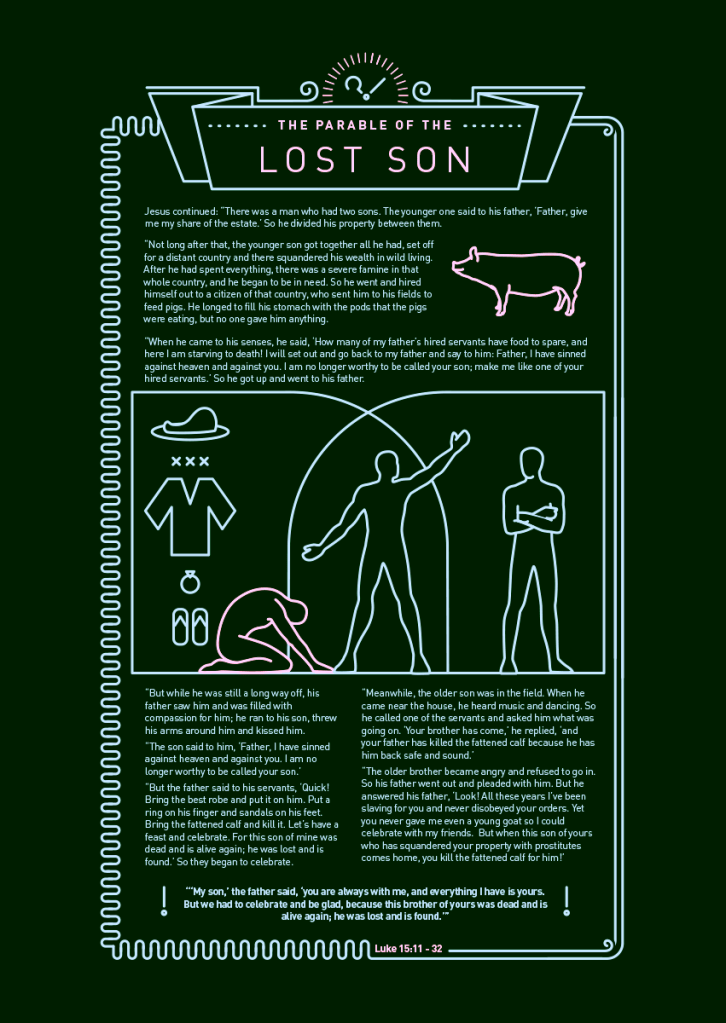
GIVE ME MY SHARE OF THE ESTATE
Delayed gratification is to most an antiquated notion, evident from the many examples in the culture all around us they perform polite forms of suicide, which is encompassed in the younger son wanting his inheritance before the allotted time. Although this request was unheard of in the ancient world, the Father nonetheless acquiesced.
What does a typical inheritance comprise of? Keep in mind that this was a son once in the Father’s household, which meant by today’s standards he had the best of everything, not too much wealth that he would be prideful, nor too little that he had to beg. He lived in a loving, kind, trusting household, where he was respected as one of the incumbent heirs. But most of all, he had the prospect of eternal life. Eternal life that came with carrying the Father’s identity without which, as we shall see, there is no life.
HOW NOT TO LIVE
The younger son set off for a ‘distant country’, in effect as far away from the Father as possible to squander his wealth. From the Greek words in use his ‘wild living’ is described as ruinous, in excess, riotous, as he wasted, spent and consumed his inheritance on sinful pleasures.
Then comes that most curious line; “After he had spent everything, there was a severe famine in that whole country”, as if Jesus was making a point that selfish squanderous living not only plunges ourselves into poverty, but the entire nation eventually suffers, magnifying our frugal responsibility to the community at large.
THE PIGS
Feeding the pigs is no small matter. It was considered one of the most degrading forms of employment not only for Jews but also in other cultures. In Egypt swine-herders were completely cut-off from society so that they couldn’t worship the gods or marry even the lowliest of women, as Jesus illustrated the depth of this young man’s misery and depravity.
The fact that the young man was not a citizen of that country meant he was not invested in the Nation’s well-being right from the start. No-one would even give him the food of the pigs suggests that he had not only become a slave, but was also starving to death.
COMING TO YOUR SENSES
How does someone, who had once been part of God’s household, come to their senses? By remembering and comparing. Notice the two.
His first and primary concern was that he no longer had anything to eat, when he ‘compared’ his current circumstance with when he was living at home, which we can also infer as the lack of physical, intellectual and spiritual nourishment in which he currently found himself.
Second is that because he was now a servant, a slave, he ‘remembered’ not the Father’s, but his Father’s servants who had food to spare as Jesus had promised in the very first parable of the Sower, that his servants would have an ‘abundance’.
The son however, remembers a lot more as can be seen by the words he rehearsed he was going to say to the Father, but in his retelling omits the last phrase wherein he requests servant-hood. He articulates his wrongs as against both ‘heaven’, the world and therefore his community at large, and against the Father, knowing that all wrongs are in every circumstance against God, completing the ‘coming to his senses’ that no-one can ever really just belong to themselves.
THE FATHER’S RESPONSE
Evidence of the Father’s beautiful character is the core and heart of this parable. Note; (1) The Father saw him a great way off, (2) had compassion on him, (3) ran to meet and welcome him home, (4) Fell on his neck and kissed him, (5) heard his confession and forgave, (6) put the best robe on him, (7) put a ring on his hand, (8) put shoes on his feet, (9) made a great feast, (10) began to be merry.
The sandals and ring were marks of honour and dignity (Esther 8:2, James 2:2, Daniel 6:17), while the shoes signifies freedom. Captives used to have their shoes removed to keep them from escaping but once liberated had their shoes returned (Isaiah 20:2).
THE ELDER BROTHER
I was born to a mother who had become a Christian a year before my birth, and to an unbelieving and antagonistic father, and even though there was much conflict in our home, my dad received his heart of flesh two decades before his death.
I mention it here because Christianity in the face of some severe obstacles for my mother made sense to me, so I never left, which makes me the older son who stayed behind while my younger brother fell off the tracks, never to return. What happens to those who have hit rock bottom, who have nothing to remember or compare against? How do they come to their senses? This parable is not for them. They are sheep and coins and it is God’s responsibility to call and for the church and its members to respond and facilitate.
In all my years by my Father’s side I had only once experienced a returning brother. Although I was happy that he did, I asked him an honest question which was perhaps not as sensitive as I would have liked. Similarly he returned after having lost everything so my question to him was why he returned to God when things were going badly in his life, but not when it was going good?
Since my awareness of being the older brother I’ve done my best to discover what those claims were I had on the Father. What access did I have, and what were all the things that belonging to Him, that I now owned? His gifts are too numerous to mention here but my advice is to get acquainted with all scripture for a start, and document for yourself all His promises.
WHAT’S AT STAKE?
When I talk to my own children to find out about how their conversations are going with unbelievers about Christianity, my son tells me that people just don’t care. My response to him is that the reason people don’t care is that they don’t know what’s at stake.
This final line, completing all three parable is the Father’s plea, wherein he equates lost and found with life and death, and not just physical life and death but the difference between eternal life or eternal torment.
The final reality is… that there is no life away from the Father.
Luke 15:11-32
 thankyoubackbone.com