
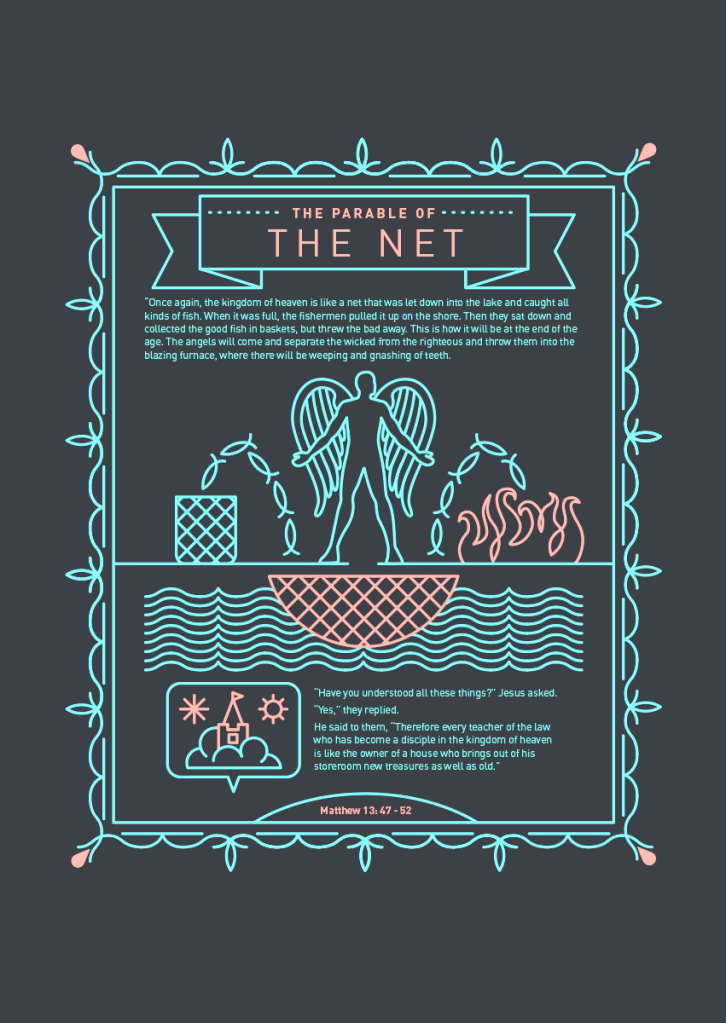
The seventh and final parable Jesus spoke on that same day repeats the final great separation of the righteous into safety, and the wicked into the fires of hell at the end of the age, and again it is the responsibility of the angels, not us for that separation, which is why we should be careful not to judge others.
THE FISH, WATER AND NET
When Jesus called the twelve disciples he promised to make them fishers of men, which is likely why Jesus uses the fish as an illustration of humankind.
A large body of water, in this instance a lake, have always been a good allegory for our existence in this world, because we need air to survive just like a fish needs water, making a good case for why we should honour our design, in other words, do what God tells us, because He made us to worship Him. Desiring anything other than putting the Lord first is akin to putting the fish on the deck of a boat. It cannot survive.
But the metaphor extends further that once we are outside the lake, outside of this life, our freedom will undoubtedly be a new kind of uninhibited freedom associated with eternal life.
Note that only when the net is full will it be drawn out. When Jesus told the disciples about the end of the age he gave them just one marker that would signal its conclusion; that the gospel would be preached to all nations (Matthew 24:14). Only God can know if this has already happened and only He knows whether that specific number of believers have been reached and captured in His net before it is drawn. In an age of social media it is hard to believe that he hasn’t already samples from every nation, tribe, peoples and tongue. (Revelation 7:9)
Jesus again concludes this introduction with the words “weeping and gnashing of teeth” to denote both regret and hatred.
THE QUESTION
Jesus asks his disciples, and by extension us reading the text, whether we have understood the words? It is an important question because he was not just referring to this parable but all seven. If we understand its meaning and implications then we’d also know that life and death, heaven and hell lies in our responses. The weight of our Lord’s question is one of immense and immediate concern fo every age.
TEACHERS AND SCRIBES
Jesus concludes all seven parables with a fitting and loaded sentence. The first word ‘therefore’ is dependent on the fact that if we truly understand the parables, then we are instructed and qualify as teachers of the laws of God and the workings of the Kingdom of Heaven.
In this instance it is helpful to consult the King James translation as well, which gives a closer description from the Hebrew in translating ‘the teacher of the law’ as also being a ‘scribe’. This is important because Jesus is known as ‘The Word’, and therefore his disciples, and by extension ourselves as believers and disciples are therefore also deployers of the ‘Word’, both spoken and written. Just like our Lord we are his ‘Words’ like he is ‘the’ Word. Our participation in the written part of the word should not be neglected. By being scribes we need to spend time writing down what we know, whether in personal study, or composing letters of encouragement to one another, or sharing insights to our broader groups. Being scribes for the Kingdom cements what we already know, establishes regular habits, makes us thoughtful individuals and grows us deeper in the grace and knowledge of our Lord.
OWNERS
If we do this then we naturally become ‘owners of a household’, whether it’s our own family or another sphere of influence. We might be part of a family but only in teaching them regularly about the Kingdom do we ‘own it’, and by ‘owning it’ means we are completely committed and invested in our households and the Kingdom of Heaven. The use of the word ‘household’ or ‘master of the house’ is also very telling because while many scriptures encourage evangelism, Jesus puts here the emphasis on our immediate surroundings. The influence we have on our friends and families I have always felt very acutely.
THE STOREROOM
Finally, there is an important characteristic Jesus lays down once we become owners of our ‘households’, which is this; that we ‘bring out of our storeroom new and old treasures’. The two questions are; what is the storeroom and what are the treasures?
The King James puts that the “master of the house…puts forth out of the treasure of him”, which suggests that we bring out of ‘ourselves’ the treasures. But because Christ is our treasure we bring out things of value out of ‘Him’ who is living in us.
It is in this the parable of the Net, that Jesus adds another dimension to the previous parable of the hidden treasure, that he is the treasure and we are the field and God is the man, pleased with his Son being revealed in us.
OLD AND NEW TREASURES
“Treasures old and new” is a Jewish idiom for ‘great and plenty’ which is why this is a fitting conclusion, because Jesus in the parable of the Sower says that if we take his words to heart we will have an abundance of spiritual gifts. But there is of course a whole lot more.
I’ve attended many churches and sat through thousands of sermons during my lifetime and one thing I’ve observed and valued are the preachers who quote both Old and New Testament in the same sermon. Old and new treasures, whether they are aware of it or not it qualifies them for preaching about the Kingdom.
Generally young people are too liberal as they try and imitate the vicissitudes of the culture around them, whilst old people are too conservative as they get set in their ways, yet both still have value. Treasure always encompasses wisdom by respecting and using things of value from the past whilst being receptive and adopting ideas that are current and new in accordance with scripture.
The word of God is a ‘Living’ word just like God refers to Himself as a ‘Living God’, which not only means that Jesus is the embodiment of that Word and alive, but by definition means that scripture must contain many old treasures as well as new applications relevant for any culture and every generation.
Matthew 13:47-52
 thankyoubackbone.com