
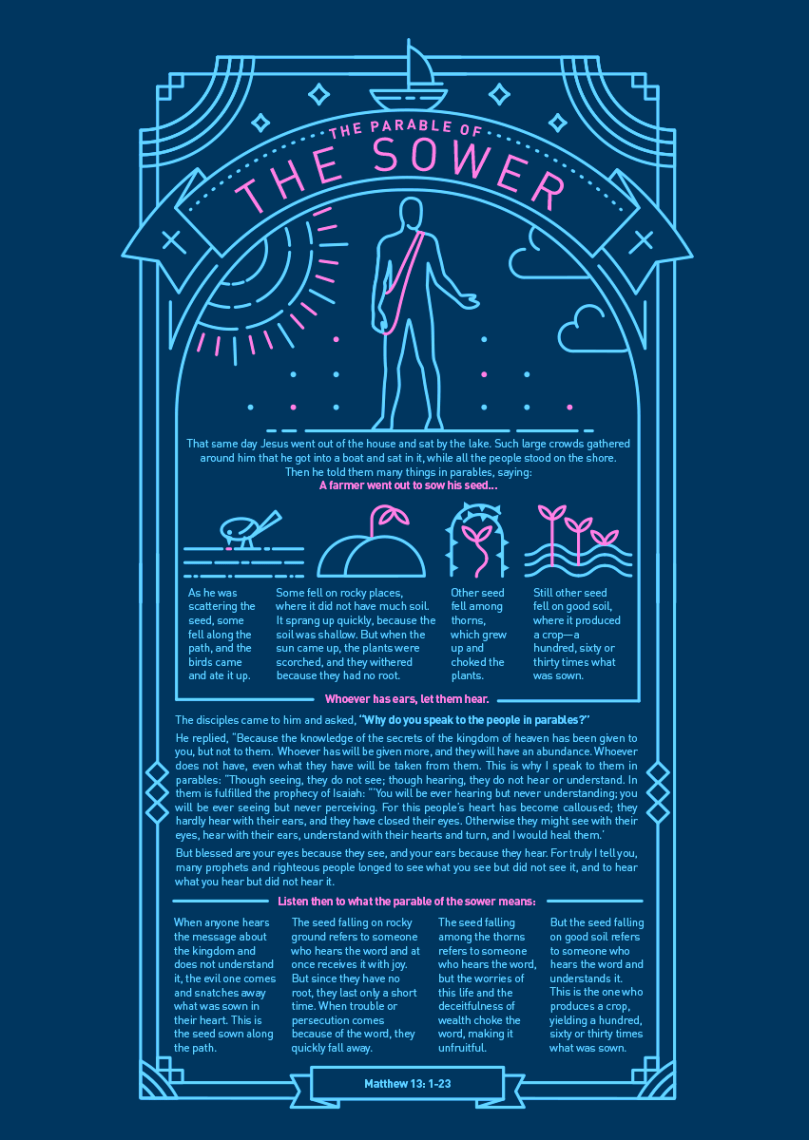
The parable of the Sower isn’t the first one our Lord spoke, but it is one of the most important because it serves as an introduction to all other parables and lays down some ground rules to their interpretations. More specifically it is a complete ‘parable package’ for 1) setting the context, 2) telling the narrative, 3) explaining the meaning or lesson of the narrative, and 4) giving the reasons why the meaning is deliberately hidden.
THE CONTEXT
It was the sabbath and by our standards we’d have to concede that Jesus was having a pretty rough day. He’d already been lambasted by the spiritual leaders for breaking the sabbath; for being called the ‘prince of demons’ after an exorcism; and after they still required a sign from him, he lashed out calling them a “wicked and adulterous generation”. In between his confrontations he healed everyone in the large crowd who were following him around and to top it all off fobbed off his own mother and brothers who were trying to get an audience with him, telling them his followers were his real family. So what does he do? He gets in a boat, sits down and in a calm, gentle and patient voice goes to his safe place telling them the parable of the sower, the first of four from the boat that day. It is likely Jesus spoke from a boat with a body of water between him and his audience for the practical reason of amplification.
THE SOWER AND THE SEED
Jesus began his parable with the words “A farmer went out to sow his seed”. It was likely still fresh in his memory that the reason the spiritual leaders criticized him was because he picked grain on the sabbath and now he was going to cement the fact that he was Lord of the sabbath, therefore having the right to the reaping. But more importantly Jesus was pointing to God as the great sower, as he did his entire life paying honour and tribute to his Father as the initiator and instigator and that he himself, the Word and the beginning (John 1), was the seed being sown.
It is important to know that Jesus ARE his words are the seeds. One cannot be planted without the other, which means that this parable has a double meaning. For instance, if the Word of God is choked, then Jesus is simultaneously choked. Jesus IS the Word. He cannot be separated from it.
THE MESSAGE
The lessons from this parable is that we have an enemy who will do all he can to prevent us from entering eternal life, the good life, the best life, and he will do so through 1) distraction and piling on worries, 2) appealing to our reptilian brains to take flight from any kind of persecution or trouble, or he will make us 3) wealthy so that we enter a deception by providing for ourselves every manner of salvation, all so that we will live an 4) unproductive and unfruitful life.
But perhaps the most important principle we can learn from this parable is the one of hearing. Listening not only with our ears but with ours hearts, which means reflection, meditation and testing the word so we may see the benefits of its application. In so doing God will accomplish what He set out to do millennia ago – writing His laws on the tables of our hearts, (Jeremiah 31:33) so that they might manifest automatically, rewiring and re-writing our very nature and character.
THE WARNING
Certainly during this particular day Jesus was challenged and confronted at every turn, which is probably why he felt compelled to remind his audience that he was binary. There is right and there is wrong. Period. There’s us and there is them. Period. Jesus deliberately divided his audience. There are secrets pertaining to the knowledge of the Kingdom of Heaven, and it was going to be given to us through these parables, and not to them. He had command over his own words and was the one who was going to explain the parables. No one else. He was going to fulfil a prophecy from Isaiah (6:9,10) that while unbelievers might hear and read these parables they will not understand the content, nor will they be able to see their implications because of three things pertaining to their hearts, ears and eyes; that 1) they cultivated calloused hearts, 2) exercised deadening and selective hearing, and 3) closed their eyes to spiritual matters. With a hint of regret Jesus confides that he wished it were otherwise so they could ‘turn’, meaning 1) spiritual conversion, and so that he could 2) heal their broken bodies.
THE BLESSING
The upside is that whoever accepts Him will be given so much information leading to knowledge, which leads to wisdom which then leads to life and on to eternal life, that they will overflow with blessings, while those who don’t will go further into darkness and ignorance until they have nothing, which is not enough sustenance to enter eternal life with, inferring there is no such thing as ‘secular stationary hiatus.’
Jesus finally makes a point of saying that whoever sees and hears, by reading and accepting these secrets and standards, ARE blessed, (not ‘will be’), because many believers before him did not experience the Saviour’s presence in the world, nor were they divulged the sheer amount and quality of the Gospel message he was about to impart.
(Matthew 13:1-23, Mark 4:1-20, Luke 8:1-15)









 thankyoubackbone.com