
I hit puberty with a vengeance, but when I started getting those wisps of brown smoke underneath my nose and around my mouth, my dad said to me; “try putting toilet paper around your face.” Toilet paper? Why? “Because you should see how wild the hair grows on my bum.” Little did my father know his repulsed son was a visual person.
Toilet paper.
No one would argue that it is something useful, and according to my dad double-ply, and because it is useful it claims a certain amount of authority, at least around one particular part of my anatomy, but trying to convince Jenni that I really need to purchase the Gretsch New Yorker because of its usefulness, is infinitely harder, mainly because of the other four guitars standing conspicuously round our living room.
What claims authority?
The Frenchman Denis Diderot, when crafting the world’s first encyclopaedia, asked that same question and answered it in one word – usefulness. If information, knowledge or even wisdom is useful, then it is no secret, we allow it to claim authority over certain parts of porous lives.
Doctors, representing various disciplines might have claims of authority, people in positions of power, those who are widely read might claim authority too, as do longstanding friendships, love interests, and as the blueprint for children unfold as they grow up, it is parents, teachers, peers and then mentors, with a very many sticking with peerdom to create fiefdoms. For others the Cartesian motto – I think therefore I am – grounds the human being in the authority of thought until such time analysis paralysis sets it. Controversially both atheism and religion claims authority because of its usefulness in eliminating guilt – with only one of those choices escaping judgement – as do many idols and addictions, which is why it becomes necessary to occasionally interrogate every so called authority if we are interested in living longer than the life-bulb in our bedside lamp. If you are not interested in the eternal life proposition then please consider that the reason might be a damaged value judgement about yourself, that no-one has yet told you how important and beautiful your Christ-infused potential beyond the pig-pen is, and that the world would be infinitely poorer without you. Managing competitive claims of authority is tricky, because we naturally look for information which supports our bias worldview, so who do I listen to?
‘Who’ might be the appropriate question, but I would like to go straight for the juice in the jugular, and ask ‘why’ should we listen to who we listen to? What is the one overriding quality that gives someone the right to speak with authority, and why should we seriously consider listening to them. Let’s skip all the stepping stones, and because we have superpowers when we write jump straight to that which invariably leads to the most noble…
Sacrifice.
If someone has demonstrated some form of sacrifice, giving up something significant to bring you something of great value, we are generally compelled to give them our attention, not so?
How about prostitution? Prostitution is sacrificial. Someone is giving up their body for the pleasure of another, in exchange for some benefit or form of remuneration, therefore we should heed the advice of its practitioners? A good friend of mine has a friend who is a female escort. He once tried to make the case that she was providing a service and no one was getting hurt. I asked him whether he was sure about no one getting hurt. After he said yes I asked him whether the males in her services were married. The answer came back yes, and so I asked him whether he thought their wives would be hurt if they found out? Sheepishly he answered yes. So it appears whilst some benefit in the exchange, others are hurt, but what if we took away the prostitutional benefits, could they then be entitled to a legitimate authority claim?
Parenthood seems likely a better model to demonstrate self-sacrifice without remuneration, which when employing and enjoying conscientiously, all but obliterates self-centeredness. Being a father myself I am acutely aware that I die first. Always. If there are three ice creams when there are four of us? I die first. I bring home work but Jai needs help with his homework, guess what, I die first. But it is a flawed model because there are benefits to both the parent and the child, cuz let’s face it, there is a warm fuzzy feeling whenever you’ve given a good thing to the little ones you love, therefore parents unfortunately do not have the ultimate claim of authority because of its mutual benefits in the framework of self-sacrifice.
But what if there were no benefits to sacrificial parenthood? What if the father was lavish, what if he sacrificed a great deal to bring his child everything he possibly could and what if that child never said thank you, or treated what he had been given with disdain and severe neglect, would that father even have the desire to maintain his generosity? Of course not. The child who has everything will not listen to a patron and there is a finitude to all things, even for the One in heaven. A father or mother might very well be a reliable authority but they are nothing but distant foghorns, if the child does not become a parent too so that he or she can have similar experiences to refer to, which might then compell them to respond appropriately. You are not going to listen to me making every reasonable pearly case I possibly could for Christ, unless something else happens first.
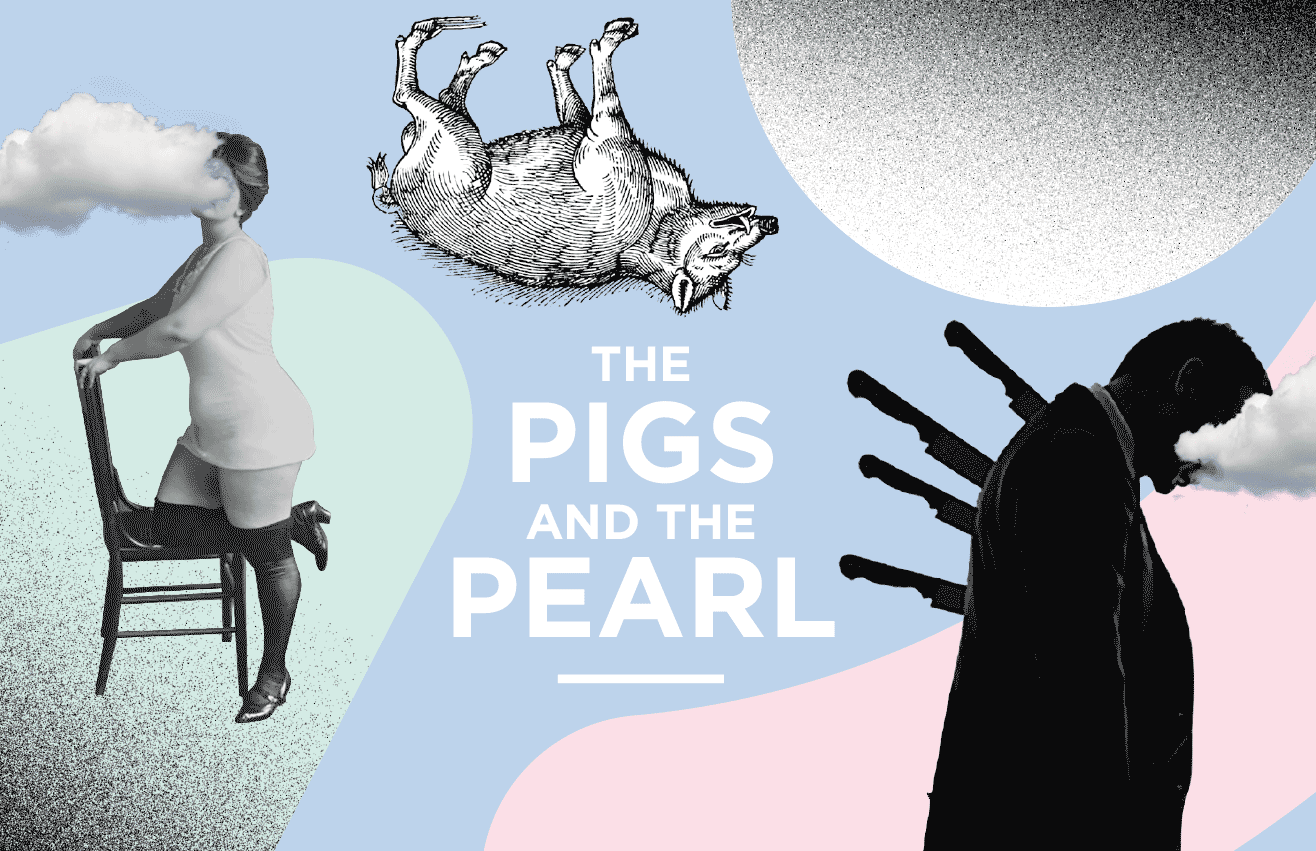
Which brings me to the pigs.
A few weeks ago I had a business breakfast with a man who runs a digital agency for one of the world’s top business consultancies. Both of us, being lay-philosophers, were at one point talking about what it is that makes a person self aware. I asked him what question he would ask to determine whether someone was self aware, he answered that he would ask that person what he did when he reached rock bottom in his life. For many reasons it was an astute answer.
The Bible tells the universal story of a prodigal son who left his father and squandered his inheritance only to reach rock bottom, where he eventually found himself feeding the pigs, longing to eat their food. In his suffering he saw the unclean, the squalor in both his surroundings and in himself, and his response was that he desired to be back with his father, even if it meant disowning himself as a son and becoming one of his father’s servants.
It is heartbreaking to see how many of us don’t make the connection between our picaresque lives and the paltry state of the world. The pigs are always ‘out there’ and never in us. We do not consider and understand that independence from God is the overriding evil in the world, because, as the story of the prodigal son demonstrates, it not only unfathomably shuns the goodness of the One who gave you birth, understands and loves you more than any other, but palpably creates real poverty in our society. We perpetuate that poverty by readily responding to the proverbial pagan prostitutes and pseudo parents, allowing them to have claims of authority over our lives, because we can’t distinguish the pigs from the pearl.
My mother used to say that my dad’s sickness mellowed him, that his suffering made him into a nicer man. His response to suffering drew him closer to God, and in doing so, he saw and related to the suffering of God’s own Son. Our suffering is wasted if it’s not viewed in light of the cross, our trials overwhelm us if it’s not shared with Him, not only because there is nothing we endure that He did not endure more, but amazingly as we confess, as we writhe, agonise, deliberate and deposit our and the world’s troubles before Him, casting the swine before our Saviour, the pigs before our Pearl, it percolates a very special bond which in turn drives an appropriate response, which is worship, being a type of surrender, opening a floodgate that allows Him to have the ultimate claim of authority over our life, so that we, from prostitutes to parents, pigs to pearl become a people of peace and praise.
Lord in heaven, see how numerous are my enemies, relieve the troubles of our hearts and free us from anguish. Look upon our affliction and distress, and take away our sins. (Psalm 25:17-18). In Jesus name. Amen
 thankyoubackbone.com