
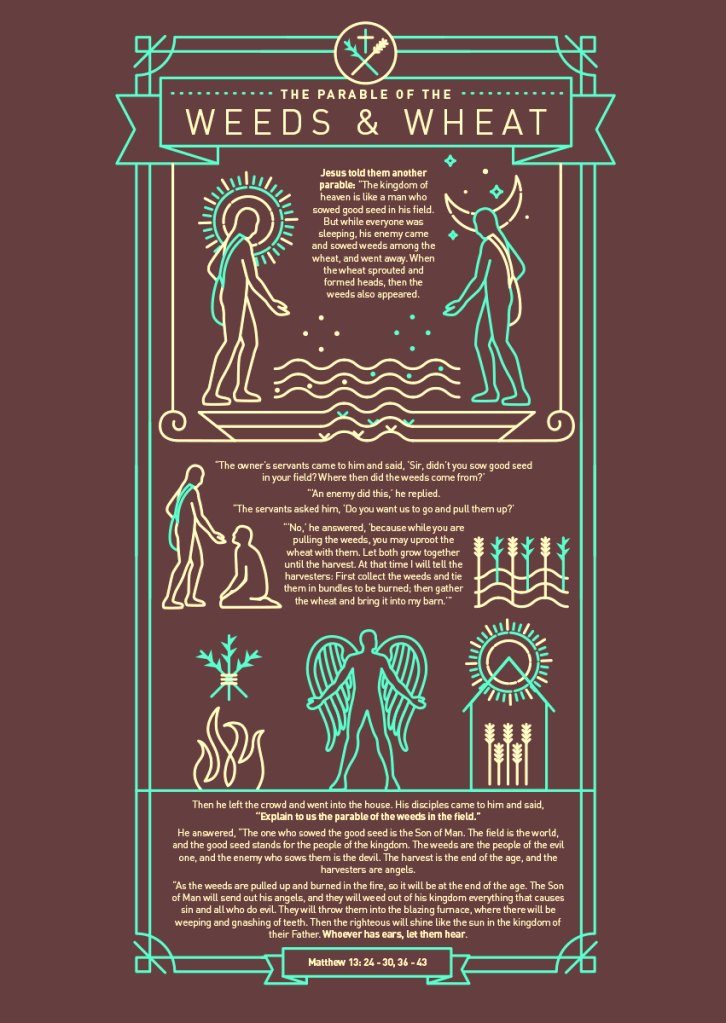
I once saw a sign outside a church which said; “Love everyone. I’ll sort them out later”, which explains this particular parable in a nutshell, the second parable Jesus spoke to the crowds from the boat. However, Jesus doesn’t offer an explanation until much later when he is alone with his disciples under roof where they ask him specifically for an explanation of this particular parable.
THE GREAT SEPARATION
In a way, this parable is an extension of the previous parable of the Sower, where Jesus expounds on the severe implications of not taking his words to heart. He once again draws the dividing line between good seed and bad seed, between good people and bad people, and between heaven and hell. There is no middle ground with Christ. Here he covers a lot of ground and his clarity is emphatic. He’s the seed. The Kingdom of Heaven is the field. The field is the world. The owner of the field, and therefore by extension the owner of the world, is himself. ‘Weeds’ are bad people belonging to the devil, who is the enemy, whereas ‘wheat’ represents the good people belonging to himself, a true friend. The harvest is the judgment at the end of the age, harvesters are the angels and the servants are those in his employ who are pastors, prophets, apostles, evangelists, teachers and priests (Ephesians 4:11, Revelation 1:6).
WHERE IS THE KINGDOM OF HEAVEN?
Many of the parables Jesus spoke begins with the phrase “the Kingdom of Heaven is like…” and so it is appropriate to answer the question as to where the Kingdom of Heaven is now? Jesus intimated that the Kingdom of Heaven began with his arrival, (Luke 17:21, Luke 22:16, John 21:10), which means that we are already and have been living in that Kingdom. It has been rapidly advancing and will eventually cover the whole earth. The Kingdom of Heaven is the physical world at present, but more than that it is viewing the physical world with a heavenly perspective and by doing so we bring spiritual living into the physical world.
That means that if we don’t address sin and become good citizens of this growing Kingdom, we will find ourselves on judgment day alienated from the world around us in the worst possible way. There’s no escaping that inevitability.
HARVESTING AT THE RIGHT TIME
From the servants’ three questions as to where the bad seed came from and what should be done, Jesus answers clearly that we have an enemy in the devil, something our modern western culture refuses to believe whilst they wallow in all kinds of squalor.
Note that while his servants asked for permission to ‘uproot’, ‘exclude’ or ‘excommunicate’, Jesus does not grant it as their responsibility, which should tell us a great deal about Christ’s leniency and incredible mercy during this age of grace. But perhaps the more important reason is that Jesus’s concern was overwhelmingly for his very own, that on judgment day it would be safer for us when it came to separating the righteous from the wicked. Safer because a bad plant’s roots might be entangled with ours which requires the surgical precision of his deity. It also explains why judging bad people now is discouraged in scripture (1 Corinthians 5:12) because it might turn away many good people who are looking on. Ultimately it reveals the heart of the Father, that He will do all He possibly can to make sure we will be saved.
Then there is the question of the wheat and weeds being ripe for harvest which begs the question; what are the signs of spiritual and nonspiritual maturity?
THE WEEDS
Depending on your translation, the word ‘weeds’ goes by another word; ‘tares’. Tares is a Zizania plant that looks like wheat while its growing, but once fully grown and ripe has ears which are long and grains that are black and poisonous. The parallel to good and bad people is startling, because there are those who might look good on the outside but their trajectory is a bad one. They might do and say wonderful things in this life but if it is selfish instead of selfless, their character growing black and poisonous. This should shock us, especially in light of Jesus’s statement that not everybody who calls him Lord will be saved (Matthew 7:21-23). How then are we saved? Only when we ‘know’ him, which is the only thing we can boast in – that we have a personal relationship with him. (Jeremiah 9:23-24)
SIN AND EVIL
On judgement day when Jesus sends his angels to ‘weed out’, he draws the distinction between ‘the things that causes sin’ and ‘those who do evil’, as if to remind us that they are different. One is brought about by things, while the other is brought about by people. Sin, once it invades, infects and matures giving birth to evil in human beings. We’d do well to answer the question as to what things causes us to sin. Because evil itself is grossly repugnant means the things that causes sin has to appear good, attractive and desirable. It is no coincidence that the devil’s original name is Lucifer which means ‘light bringer’. He will not present our destruction as repulsive.
This pairing reflects the parable itself, that weeds and wheat both look the same while growing but are very different, just like sin and evil, though they might seem the same, are also very different. It can be said that sin is ‘cause’ while evil is ‘effect’.
We live in a world that tries to fix ‘symptoms’, ‘effects’, rarely addressing the causes, the root problems. But here we have a picture of hell, where both cause and effect are incinerated.
WEEPING AND GNASHING
Weeping and gnashing is mentioned again in the ‘Bags of Gold’ parable and denotes two attitudes. The first is ‘weeping’, the overwhelming regret that the boat was missed, that having heard of Jesus persons felt they had the choice to reject him, but conveniently forgetting (2 Peter 3:5) that there is consequence to that rejection. The second attitude is ‘gnashing of teeth’, that even in the face of every conceivable benevolence they still chose to not only reject Christ but to loathe him utterly, so that even when entering the fires of hell they burned with hatred.
EARS FOR HEARING
“Whoever has ears, let him hear.” As we move through these parables which form the core of Jesus’s teaching and take his words to heart, we also can’t help but get to know his quirks and idiosyncrasies, like his black and white outlook on life for one. Jesus’s reference to hearing is another which he utters fifteen times in the gospels and seven more times in the book of Revelation as a way of not only calling special attention to what’s being said, but the simplicity of salvation, that is to say, if you have ears, then put them to use. Ultimately it is nothing more than good listening which prompts the right actions towards salvation.
Matthew 13:24-30, 36-43
 thankyoubackbone.com